above video courtesy of abc news
below article and infographic by The International Prostate Cancer Foundation
read the blog feature here
Renowned robotic surgeon performed the very first FDA IDE approved human clinical trial transcontinental robotic telesurgery
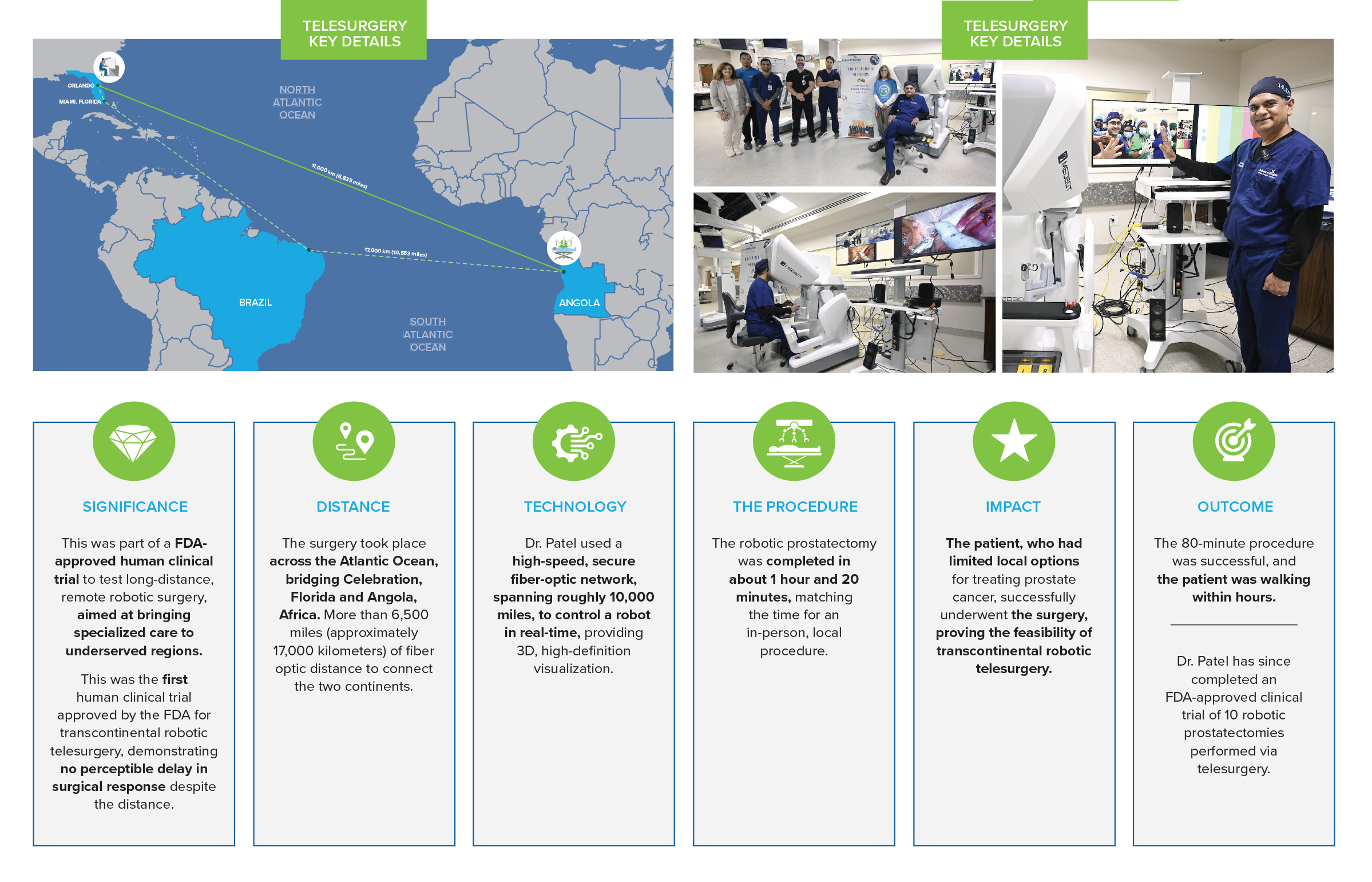
On June 14, 2025, Dr. Vipul Patel completed a historic remote telesurgery. Operating from AdventHealth’s Global Robotics Institute in Florida, he successfully conducted a robot-assisted radical prostatectomy on a 67-year-old patient in Africa with stage one prostate cancer.
For this procedure, Patel’s surgical team utilized a direct fiber optic network that originated in Orlando, moved down through Miami and then on to Brazil before crossing over the Atlantic Ocean to Angola across a distance of more than 7,000 miles (approximately 17,000 kilometers) of distance.
This marks the first robotic telesurgery from the U.S. to an international location since 2001. That procedure, which was famously called the ‘Lindbergh Operation’ and involved the removal of a gallbladder, was performed by Dr. Jacques Marescaux via the French Embassy in New York City on a patient located in Strasbourg, France.
However, due to challenges with telecom speed, the viability of robotic technology and the immense cost at the time, it hasn’t been reproduced since.
The advent of lower cost and more capable robotic surgical systems and the evolution of telecommunications (5G and fiber optic cable) has solved many of the bandwidth, latency and connectivity issues that previously precluded the performance of such a complex procedure at a long distance creating the ability to teach surgeons and deliver patient care remotely.
According to Patel, this first-of-its-kind FDA-approved IDE human clinical trial for U.S. based transcontinental robotic telesurgery to Africa is a stunning breakthrough that medical professionals believe could be the first step in providing the ultimate in healthcare equity for those in remote, rural and underserved areas who currently lack access to advanced surgical education and high-quality healthcare.
Patel, who has performed over 20,000 prostatectomies using robotic technology and is widely recognized as the world’s pre-eminent prostate cancer surgeon, noted that most of the world’s population does not have access to experienced medical teams and believes robotic telesurgery has the potential to solve a massive, global healthcare problem.
In addition to overcoming geographical distances, robotic telesurgery can also bridge temporal gaps, allowing surgeons to respond swiftly to emergencies or time-sensitive procedures. Along with the practical applications of robotic telesurgery, the humanitarian, social and medical benefits are potentially limitless.